

Table of contents
Dining room wall lights work best in pairs, with the bottom of each light about 60 cm above the table top: around 1.35 m from the floor with a standard 75 cm table. Give them their own switch, separate from the pendant, and fit warm white bulbs of 2,700 K on a dimmer.
A dining room is used for more than dinner. Homework spreads across the table on a Tuesday, the Christmas dinner runs on into the evening, and a light that suits one of those moments rarely suits the next. A single pendant or a ceiling light puts all the brightness in one place. Wall lights add the second layer, the light on the walls and on faces, and they are what lets you turn the room down without sitting in the dark. This guide covers what wall lights do in a dining room, how high to hang them, how many you need, which models suit and what an electrician has to do in an Irish home.
Pendant or wall lights: what each one lights
Two areas need light in a dining room, and they do not need the same amount. Our advice is about 300 lux on the table top, enough to serve, carve or read a recipe, and about 150 lux in the rest of the room, enough to walk around and find things in the sideboard. A lux is one lumen falling on one square metre. A review of lighting trials in interiors (Fotios, 2017) found that rooms lit to less than about 300 lux were judged less pleasant, with no colour temperature preferred. Keep the table well lit, then, and dim the light around it once the meal settles in.
The pendant is the most efficient source for the table, because it hangs close to the plate. licht.de, the German lighting information centre, gives about 60 cm between the table top and the bottom of the fitting: the light stays on the table and you can still see the person sitting opposite. Keep its diameter under half the width of the table, and use two pendants over a long table.
Wall lights do a different job. They light the walls, which makes the room look larger, and they soften the shadows a pendant casts on faces. On its own, a pendant leaves the edges of the room dark and turns the tablecloth into a stage. On their own, wall lights cannot put 300 lux on the middle of a table that stands 1.50 m from the wall. Use both, each on its own switch, as licht.de also recommends.
Plenty of Irish dining rooms, and many kitchen extensions with a dining end, have no lighting point above the table. The wall lights then become the main light. Three solutions, from the simplest to the most involved:
- move the table closer to the wall that carries the lights, so they are less than a metre from the table top;
- choose wall lights that send plenty of light downwards as well as upwards, and add a table lamp on the sideboard;
- have a lighting point installed above the table. That means a cable, a box in the ceiling and a switch, run to I.S. 10101, the National Rules for Electrical Installations: a job for a Registered Electrical Contractor, never an extension lead taped across the ceiling.
How high should dining room wall lights be?
Two sight lines decide the height. People sitting at the table have their eyes about 1.20 m from the floor; people standing or walking around it look from much higher. Our rule is to put the bottom of the light about 60 cm above the table top, which with a 75 cm table means around 1.35 m from the floor. The light then sits above the eyes of anyone seated, close enough to the table for its glow to reach the plates, and low enough to read as part of the dining area rather than the ceiling.
Where the middle of the light ends up depends on its size. A 25 cm round wall light hung that way has its centre at about 1.48 m; a tall wall light of 56 cm has its centre at about 1.63 m, its top above 1.90 m. Both look right, because they share the same bottom line and the eye reads them against the table.

Two situations change the rule. When the table runs along the wall, or diners sit on a bench with their backs to it, raise the bottom of the lights to 1.50 m at least, so heads pass under them even with a chair pushed back. And where the wall light sits on a narrow passage between the table and the wall, keep it slim, about 12 cm or less from the wall, so nobody catches it on the way past.
| Situation | Our guide | Why |
|---|---|---|
| Wall lights over a sideboard or on the wall facing the table | Bottom about 60 cm above the table top, around 1.35 m from the floor | Above seated eye level, close enough to light the table |
| Wall lights behind a bench or along a table pushed to the wall | Bottom at 1.50 m at least | Heads pass underneath, chair pushed back or not |
| Wall light in a narrow passage | 12 cm or less from the wall | No shoulder or tray catches it |
| Pendant over the table | Bottom about 60 cm above the table top | Light on the plates, clear view across the table |
| Pendant away from the table | 2.15 m clear headroom under it | Nobody has to duck |
Measure all of these from the finished floor. Under a low ceiling, 2.40 m or less, keep the same heights and pick a light that throws most of its light downwards, to avoid a bright patch on the ceiling. Weight is rarely a problem: a plasterboard fixing holds 3 to 10 kg depending on the board and the studs behind it, provided you use the plug made for it. The light connects to a junction box. If there is no cable coming out of the wall where you want it, getting one there is a job for a Registered Electrical Contractor.
How many wall lights, and where to put them
In a dining room, wall lights work in pairs, because the room is built around lines: the table, the sideboard, the fireplace or the window. Our advice, layout by layout:
- A sideboard against a wall: two wall lights, one over each end of it, as in our photo. They light the top of the sideboard and give you a working light when you clear the table. Over a 2 m sideboard, that puts them about 1.70 m apart.
- A long table along a wall: three or four wall lights, 1.20 to 1.50 m apart, so the pools of light meet and nobody eats in a dark gap between two guests.
- A table in the middle, no sideboard: one pair on the wall you see most from the table, often either side of a painting or a mirror, which the light frames.
- A chimney breast: one light in each alcove, or one either side of the breast itself. It is the classic layout of older Irish homes and still the most balanced.
- A dining area open to the sitting room: the wall lights mark out where the dining space starts. Keep the same finish, or at least the same colour of light, as the living room wall lights on the sofa side; our cosy living room ideas deal with the other half of the room.
With the pair placed, check the spacing against the furniture rather than the wall. Two lights that line up with the ends of the sideboard, or with the edges of a painting, look intended; the same lights placed by eye on a bare wall often end up slightly off centre, and you notice it every time you sit down.

Which wall light suits a dining room?
The question that matters most at the table is glare. Seated diners look straight across the room, at the height of the lights on the far wall, and a bare bulb at that height ends up in someone’s eyes for the whole meal. Lights that hide their source avoid the problem, and four families do it well.
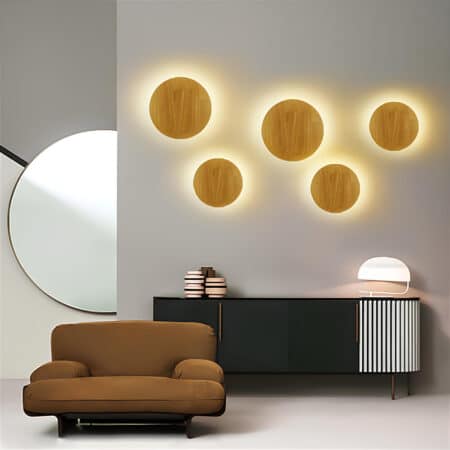
- Backlit discs and halos. The light source sits behind an opaque front and lights the wall around it. Our round wooden wall light works that way: a 25 cm disc of natural wood in size M, with a warm ring of light on the plaster and nothing bright to look at. It suits a calm, Scandinavian or Japandi dining room, and it can go lower than a light with a visible bulb.
- Up and down lights. They draw two lines of light on the wall, hide their bulbs and suit almost any style. The gold Art Deco wall light with ribbed glass tubes, 56 cm tall and 12 cm wide in size M, brings sparkle to a more formal room. It is hardwired through a junction box, with no plug and no switch on the light.
- Fabric shades. A shade softens the light and adds warmth even when it is off. The wall light in beige fabric and gold-coloured metal, 28 cm wide and 30 cm high, lets the light out of the top and the bottom of its shade.
- Opal glass. A milky globe hides the bulb completely and spreads an even light: our guide to opal glass explains how it differs from frosted glass.
Shape follows the room. Round fronts soften a dining room full of straight lines, from the table to the sideboard and the door frames; the round wall light collection gathers them. Tall, slim models suit a narrow wall between two doors. For more statement pieces, browse our design wall lights.
Plug-in wall lights are an option when there is no cable in the wall and you rent, or simply do not want to open up the plaster. Choose a model sold with its plug, never a hardwired light converted with a length of flex, and tidy the cable properly: here is how to hide wall light cables safely.
Warm white, colour rendering and dimmers
Colour temperature is printed on the bulb box in kelvin. A warm white of 2,700 K, or 3,000 K at most, gives food and faces a natural colour in the evening. Use the same value in the pendant and the wall lights: two different whites show up straight away on a pale wall.
Colour rendering matters at the table too. Commission Regulation (EU) 2019/2020 sets a colour rendering index (CRI) of at least 80 for light sources sold in the European Union. Our advice is to choose 90 or more when the packaging gives it, so that meat, vegetables and red wine keep their real colour.
A dimmer lets you keep 300 lux on the table to serve, then bring the room down to a soft, low light, in the order of 20 lux, once the plates are cleared. Not every LED bulb dims: the same regulation requires the packaging to say when a light source is not compatible with dimmers, or only with some of them. Check that line before you buy. Swapping a switch for a dimmer is a job for a Registered Electrical Contractor.
To read the brightness of a bulb, Commission Delegated Regulation (EU) 2019/2015 gives the official equivalences: 470 lumens correspond to an old 40 W bulb, 806 lumens to a 60 W bulb and 1,521 lumens to a 100 W bulb.
A worked example: a 3.3 by 4 m dining room
To turn lux into lumens, our house rule fits on one line: lumens to install = area in square metres x target lux x 2. The factor of 2 covers the light lost in shades, walls and ceiling. Take a dining room of 3.3 by 4 m, with a 2.40 m ceiling and pale walls, a table of 180 by 90 cm in the middle and a 2 m sideboard against the end wall.
- Table, 300 lux: 1.62 square metres x 300 x 2 = about 970 lumens aimed at the table. A pendant with two 470 lumen bulbs (940 lumens) comes within 3 per cent, which a dimmer turned up absorbs.
- Room, 150 lux: 13.2 square metres x 150 x 2 = about 3,960 lumens in total, table included. That leaves roughly 3,000 lumens for the walls.
- Wall lights: a pair over the sideboard and a pair on the opposite wall, four lights in all, at about 750 lumens each. With bulbs, four 806 lumen bulbs give 3,224 lumens. With integrated LEDs, read the lumen figure on the product page or the box, not the wattage.
- Control: wall lights and pendant on two separate switches, each on a dimmer, all at 2,700 K.
The same room without a ceiling point over the table runs on its four wall lights alone. Pull the table to about a metre from the sideboard wall, so the pair there reaches the plates, and keep a lamp on the sideboard for the end of the table that stays darker.
One last check before you order: look at the room at night with the lights you already have. The darkest corner, often the one by the door or behind the chair at the head of the table, is where the second pair of wall lights earns its place.
Dining room wall lights: frequently asked questions
How high should wall lights be in a dining room?
Put the bottom of the light about 60 cm above the table top, around 1.35 m from the floor with a 75 cm table. That keeps it above seated eye level, about 1.20 m. Behind a bench or along a table pushed to the wall, raise the bottom to 1.50 m at least.
What is the rule of thumb for lighting over a dining table?
About 300 lux on the table: area in square metres x 300 x 2 gives the lumens, so roughly 970 lumens for a 180 by 90 cm table. A pendant hangs with its bottom about 60 cm above the table top and stays under half the width of the table.
How many wall lights do I need in a dining room?
Two at least, as a pair: either side of a sideboard, a mirror, a painting or a chimney breast. Along a table longer than 3 m, three or four lights 1.20 to 1.50 m apart avoid dark gaps between guests.
What colour light is best for a dining room?
Warm white, 2,700 K or 3,000 K at most, the same in the pendant and the wall lights. Choose a CRI of 90 or more when the box gives it; 80 is the legal minimum in the EU.
Can you light a dining room with wall lights only?
The room, yes; the table, less easily, because wall lights 1.50 m from the table cannot put 300 lux on it. Move the table closer to the lit wall, choose lights that also shine downwards and add a lamp on the sideboard.
Are plug-in wall lights a good idea in a dining room?
They are a good answer when there is no cable in the wall. Choose a light sold with its plug and tidy the flex. A hardwired light must not be turned into a plug-in one: if you want a new lighting point, call a Registered Electrical Contractor.
Sources
- Esszimmer, section Wohnen (about 60 cm between the table top and the bottom of a pendant, lights switched separately, dimming). licht.de, lighting information centre of the German electrical industry association ZVEI
- Commission Regulation (EU) 2019/2020 laying down ecodesign requirements for light sources, Annex II, Table 4 (CRI of at least 80) and point 3 (information on dimmer compatibility). Official Journal of the European Union
- Commission Delegated Regulation (EU) 2019/2015 on the energy labelling of light sources, Annex V, Table 7 (equivalence between luminous flux and incandescent bulb wattage). Official Journal of the European Union
- Fotios S., A revised Kruithof graph based on empirical data, LEUKOS, 2017, vol. 13, no. 1, pp. 3 to 17. doi:10.1080/15502724.2016.1159137
- I.S. 10101, National Rules for Electrical Installations. National Standards Authority of Ireland (NSAI), presented by the Health and Safety Authority
- Works Needing Certification: Controlled Works and Restricted Works, section 9E(1) of the Energy (Miscellaneous Provisions) Act 2006. Health and Safety Authority
- Electrical works in your home: use a Registered Electrical Contractor. Safe Electric, the scheme operated for the Commission for Regulation of Utilities (CRU)
Related products

Wall Light in Beige Fabric and Gold-Coloured Metal

Gold Art Deco Wall Light with Ribbed Glass Tubes
Round Wooden Wall Light
Find out more

Indirect Lighting: How a Wall Light Lights the Room Through the Wall and Ceiling

Dining Room Wall Lights: How High, How Many and Which Light to Choose

GU10 Bulb: Lumens, Beam Angle, GU10 vs MR16 and How to Change One


