

Table of contents
Indirect lighting sends the light onto a wall or a ceiling first, and that surface passes it back into the room, softened: you see a glowing surface, never the bulb. With a wall light, three numbers decide the result: the gap to the ceiling, about 60 cm, how pale the surface is, and the lumens, which go up as the wall gets darker.
Turned towards the wall, a wall light makes the plaster the light fitting, as long as the wall plays along: matt white returns about 80% of the light, navy less than 7%. Here is how to size it, where to mount it under an Irish ceiling and what to keep as direct light.
What is indirect lighting?
With indirect lighting, the fitting does not point at what it has to light. It throws its light at a surface, the ceiling, a stretch of wall, the inside of a cove, and that surface acts as the reflector. The light reaching the sofa has bounced once and arrives from every direction: hence its softness.
Direct lighting does the opposite: the light goes straight from the bulb or the shade to the area to be lit. A fitting that combines the two, mostly indirect, is called semi-indirect. Énergie Plus, the building lighting resource of the Université catholique de Louvain, sets out the strengths and weaknesses of all three.
| Type of lighting | Path of the light | What you see | Use at home |
|---|---|---|---|
| Direct | from the source straight to the area | the bulb or its shade, crisp shadows | reading, cooking, a table |
| Indirect | onto the wall or ceiling, then into the room | a glowing surface, hardly any shadow | evening mood, hall, bedroom |
| Semi-indirect | both, mostly indirect | a halo plus a little light downwards | living room, high ceilings |
A bulb packs its light into a few square centimetres; a halo spreads it over a square metre of plaster, so the eye finds no bright point to lock onto: the best protection against glare in the evening. Two catches: part of the light stays in the wall, so you need more of it, and light from everywhere casts almost no shadows, so a room lit only indirectly looks flat.
Wall colour: how much of the light comes back
Every surface returns a share of the light that falls on it, its reflectance, from 0 (all absorbed) to 1 (all returned). It depends on how light or dark the shade is far more than on the hue. The link between lightness and reflectance was measured in 1943 by the Optical Society of America committee on the Munsell colour system (Newhall, Nickerson and Judd); our orders of magnitude below are drawn from it, for matt paints.

Say your wall light sends 470 lumens onto the wall, the output of a bulb equivalent to an old 40 W. Matt white sends 375 to 425 back into the room, mid grey or taupe only 140, navy or forest green 15 to 35. These are first-bounce figures: a pale room does a little better as the light keeps bouncing, a dark room hardly does.
The wall also tints the light: a halo on terracotta turns orange, pale sage lit by a 2,700 K LED greys a little, a white ceiling hands the light back almost unchanged. On dark or strongly coloured walls, aim at the ceiling and keep the halo as an effect. Keep the surface matt, too: satin or gloss mirrors the bulb back at you. For offices, I.S. EN 12464-1 gives reflectances of 0.7 to 0.9 for ceilings and 0.5 to 0.8 for walls: not a rule for a home, but proof that reflected light needs pale surfaces.
How many lumens for indirect lighting?
Our basic rule: lumens to install = floor area in square metres × target lux × 2, the factor of 2 covering what shades and surfaces absorb. We aim for about 20 lux for a dim evening, 100 for tidying up. A living room of 4 by 4 m, 16 m², needs 16 × 20 × 2 = 640 lumens for an evening mood.
With indirect lighting, all the light goes through the surface you aim at. Our adjustment: multiply by 0.8, the factor of matt white, then divide by the factor of that surface. A darker wall pushes the figure up fast.
| 16 m² living room, evening at 20 lux | Surface factor | Lumens to install | With 470 lm wall lights |
|---|---|---|---|
| Matt white ceiling | 0.8 | 640 lm | 2 wall lights (940 lm) |
| Linen or light beige wall | 0.65 | 640 × 0.8 ÷ 0.65 = 790 lm | 2 wall lights (940 lm) |
| Pale sage green wall | 0.5 | 1,024 lm | 3 wall lights (1,410 lm) |
| Mid grey or taupe wall | 0.3 | 1,710 lm | 4 wall lights (1,880 lm) |
| Terracotta wall | 0.15 | 3,410 lm | 8 wall lights: aim at the ceiling instead |
Lumens are printed on the bulb’s box. Commission Delegated Regulation (EU) 2019/2015 (Annex V, Table 7) sets the official equivalences: 470 lumens for an old 40 W bulb, 806 for a 60 W. A whole room at 100 lux would need 3,200 lumens here, four 806 lumen lights aimed at a white ceiling: in most homes indirect light carries the evening and the ceiling light gives full brightness. Our guide to ambient lighting puts numbers on each of those layers.
How high to mount an indirect wall light
For a light that shines up, what matters is the gap between its top and the ceiling. The light on a surface drops with the square of the distance: at 30 cm, the spot above the fitting gets four times as much light as at 60 cm, and the halo turns into a sharp, dazzling patch. Beyond a metre, it thins out. For a light opening at 90°, the patch is about twice the distance wide: 1.20 m at 60 cm. Two lights 1.20 m apart draw one continuous band; 2 to 3 m apart, two separate halos.
The open top of an uplighter must also sit above standing eye level, usually 1.50 to 1.75 m (about 4 ft 11 to 5 ft 9), or you see the bulb. We have based the table on a 2.40 m ceiling, a height you will meet in a great many Irish homes, and that is where the classic uplighter runs short of room.
| Type of wall light (2.40 m ceiling) | Centre of the light | Why |
|---|---|---|
| Uplighter (bowl open at the top) | about 1.75 m | top about 55 cm under the ceiling, the minimum; opening at a tall adult’s eye level |
| Up and down (two fans on the wall) | 1.55 to 1.65 m | room for the upper fan to open, lower fan above a sofa back |
| Halo around a disc | 1.50 to 1.70 m | source hidden from every angle, halo at eye level |
Under a 2.70 m ceiling or higher, as in many period houses, raise an uplighter by 10 to 20 cm. From a staircase or a landing, though, a light open at the top shows its whole inside: there, and under any ceiling of 2.40 m or less, a halo disc or an up and down model is the better choice.
If there is no cable coming out of the wall at the right height, getting one there, like adding a circuit or fitting a dimmer, is a job for a Registered Electrical Contractor working to I.S. 10101, the National Rules for Electrical Installations; you can check that yours is on the Safe Electric register. See also our guide to hiding wall light cables.
Three wall lights that light through the wall
Among our round wall lights and other models, three from our fast delivery stock show three ways of letting the wall do the lighting:
- A halo around a disc: the round wooden wall light, in size M a 25 cm disc of pale wood with a supplied LED source fitted behind it. The light only reaches the wall behind the disc, with no source in sight even from the stairs: the model for a low ceiling.
- Up and down: the Scandinavian ribbed resin wall light, 16.5 cm tall according to its product page, in green, grey, orange or white. The ribbed body hides its G9 bulb and the light leaves at the top and the bottom, in two fans against the wall: semi-indirect light.
- A pattern of light: the light and shadow wall light, a brushed aluminium cylinder 5.5 cm across and 7 cm deep, with an integrated 3 W LED. Its perforations throw a rosette of light dots onto the plaster: an accent for a hall or a landing rather than light for the room.

All three are indoor wall lights, for the living room, a bedroom, the hall or the landing. Our design wall lights include other shapes that light the wall. An LED strip in a cove does the same but needs a profile, a driver and building work; a wall light goes on an existing lighting point.
Keep some direct light, and the mistakes to avoid
Indirect light is not enough to read by: the workplace standard asks for 500 lux for reading in an office, twenty-five times an evening mood at 20 lux. Pair it with a direct source close to the page, such as a reading wall light beside the armchair or the bed. Our cosy living room ideas give the measurements for the sofa wall and the armchair corner. And direct light need not be harsh: a globe in opal glass spreads it over its whole surface and hides the bulb.
The mistakes we see most often:
- Aiming at a dark surface: dark beams or a navy wall return less than 7% of the light.
- Mounting too close to the ceiling: under 30 cm, the patch draws a hard, bright circle. Keep the top at least 55 cm down.
- Mixing colour temperatures: a 2,700 K halo beside a 4,000 K one shows at once on a pale wall. Use one value per room, 2,700 K for the evening, with a colour rendering index of at least 80, the minimum set by Regulation (EU) 2019/2020, which also requires the box to say when a bulb cannot be dimmed.
- Forgetting the dusting: an open bowl collects dust and insects. Wipe it each season, light off and cold.
Indirect lighting: frequently asked questions
What exactly does indirect light mean?
Light that does not reach what it lights directly: the fitting sends it onto a wall, a ceiling or a cove, which passes it back into the room, diffused. You see a glowing surface rather than the bulb, so there is no glare.
What is the difference between direct and indirect lighting?
Direct light goes straight from the source to the area: efficient, with crisp shadows and a risk of glare. Indirect light bounces off a surface first: no visible source, but it takes more lumens and depends on the colour of the wall or ceiling.
What are the three types of lighting in interior design?
Ambient light for the whole room, task light for reading or cooking, and accent light for a picture or a wall. An indirect wall light belongs on the ambient side; by direction, lighting is also direct, indirect or semi-indirect.
How high should an indirect wall light be?
Under a 2.40 m ceiling, centre a halo disc at 1.50 to 1.70 m and an up and down light at 1.55 to 1.65 m. An uplighter needs its top at least 55 cm below the ceiling, which is easier at 2.70 m.
Can indirect lighting light a whole room?
Yes, with enough lumens and pale surfaces: about 3,200 lumens for 100 lux in 16 m², four 806 lumen wall lights aimed at a white ceiling. Most homes keep indirect light for the evening and a ceiling light for full brightness.
What are the disadvantages of indirect lighting?
It needs more light for the same result, loses a lot on dark surfaces, casts few shadows and shows up flaws in the ceiling. It is not enough for reading: keep a direct light beside the armchair or the bed.
Sources
- Éclairage indirect, Éclairage direct, Éclairage mixte, technical sheets on types of lighting. Énergie Plus, Architecture et Climat, Université catholique de Louvain
- Newhall S. M., Nickerson D., Judd D. B., Final report of the O.S.A. subcommittee on the spacing of the Munsell colors, Journal of the Optical Society of America, 1943, vol. 33, no. 7, p. 385. doi:10.1364/JOSA.33.000385
- Commission Delegated Regulation (EU) 2019/2015 on the energy labelling of light sources, Annex V, Table 7. Official Journal of the European Union
- Commission Regulation (EU) 2019/2020 laying down ecodesign requirements for light sources, Annex II, Table 4 and point 3. Official Journal of the European Union
- I.S. EN 12464-1, Light and lighting, Lighting of work places, Part 1: Indoor work places. National Standards Authority of Ireland (NSAI)
- I.S. 10101:2020, National Rules for Electrical Installations. National Standards Authority of Ireland, presented by the Health and Safety Authority
- Find a Registered Electrical Contractor. Safe Electric, the scheme of the Commission for Regulation of Utilities
Related products
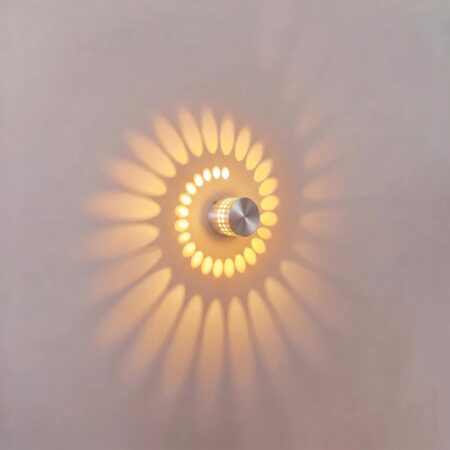
Wall light design Light and Shadow Play
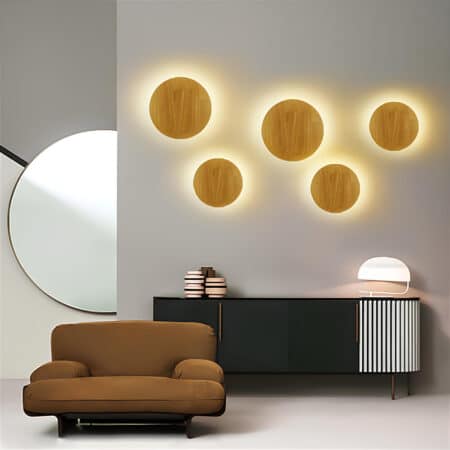
Round Wooden Wall Light

Scandinavian Ribbed Resin LED Wall Light
Find out more

Ambient Lighting: the Three Layers of Light and Where Wall Lights Fit

Indirect Lighting: How a Wall Light Lights the Room Through the Wall and Ceiling

Dining Room Wall Lights: How High, How Many and Which Light to Choose


