

Table of contents
To hide cables on wall lights that plug in, run the flex in slim trunking or a cord cover painted the wall colour, fix it in clean straight lines, or let it drop behind furniture, all without touching the wiring. For a cable you cannot see at all, the light has to be wired to an outlet in the wall: that is a job for a Registered Electrical Contractor.
A wall light cable is harder to hide than a television lead. It starts at a point of light, on a wall that the lamp itself lights up, often at eye level. Before buying any trunking, find out which kind of cable you are dealing with, because that decides what you can do yourself and what you cannot. Here are the six options, from the quickest to the most involved:
- slim trunking or a cord cover, painted the colour of the wall;
- a half-round cable cover for a single flex;
- a flex left on show, clipped in straight lines;
- a route behind a headboard, a sideboard or a picture;
- a light wired to an outlet that is already in the wall;
- a new lighting point, with chasing or a run through the stud wall, by a Registered Electrical Contractor.
Plug-in or hardwired: which cable are you hiding?
A plug-in wall light is an appliance. Its flex runs from the lamp down to a socket, like a bedside lamp, and hiding that flex is a decorating job. In Ireland its plug is the 13 A fused plug made to I.S. 401, fitted with the fuse the maker specifies: S.I. No. 525 of 1997 sets that rule for plug-in domestic appliances sold here. A hardwired wall light is fixed over an outlet in the wall. That outlet belongs to the electrical installation of the house, which is covered by I.S. 10101, the National Rules for Electrical Installations.
| Plug-in wall light | Hardwired wall light | |
|---|---|---|
| What leaves the wall | Nothing: the flex runs from the lamp to a socket | A cable in a box, hidden by the back plate |
| What you hide | The flex, from the lamp to the socket | Nothing, if the outlet is in the right place |
| What you can do yourself | Trunking, cord covers, clips, routes behind furniture, without cutting or altering the flex | Choose the light and its height |
| Work for a Registered Electrical Contractor | Adding or moving a socket | Connecting the light, creating, moving or extending an outlet, chasing included |
| Reference | The instructions and the plug of the appliance | I.S. 10101, the National Rules |
Whichever model you pick in our wired wall light range, read its installation details first: they tell you which kind you have. On our gold Art Deco wall light with ribbed glass tubes, for example, the details say it is wired to the mains through a junction box, with no plug and no switch on the light, and it is a Class I fitting that needs an earth. A light like that does not become a plug-in lamp with a length of flex and a plug: if there is no outlet where you want it, call a Registered Electrical Contractor or choose a light designed to plug in.
Trunking, cord covers and clips: hiding a flex without touching the wiring
Three profiles share the work. Mini trunking is a flat channel with a base fixed to the wall and a lid that clips shut; it takes one or two flexes. Wider trunking carries several leads along a skirting board or a desk. A half-round cord cover, usually self-adhesive, sits over a single flex and is the least visible of the three on a flat wall. Our tip: choose a channel a millimetre or two wider than the flex, so the lid closes without pinching it.
Work out the length before you buy. For a light centred 1.60 m above the floor and a socket 30 cm up, set 80 cm to one side, you need 1.30 m going down and 80 cm across: 2.10 m of trunking, plus about 10 % for the corner cuts. Check that the flex is long enough too. If it is not, never cut it to add a piece or swap the plug: move the light closer to the socket, or have a Registered Electrical Contractor add a socket.
On sound paint, the adhesive backing is enough. On flaky plaster or bare plasterboard, screw the trunking with suitable plugs, drilling beside the flex and never through it, and away from any cable that may already run in the wall. Our guide to installing a wall light without drilling covers adhesive fixings in more detail. Then paint the trunking with the wall paint, in the same finish: a satin channel on a matt wall catches the light as soon as the lamp is switched on.
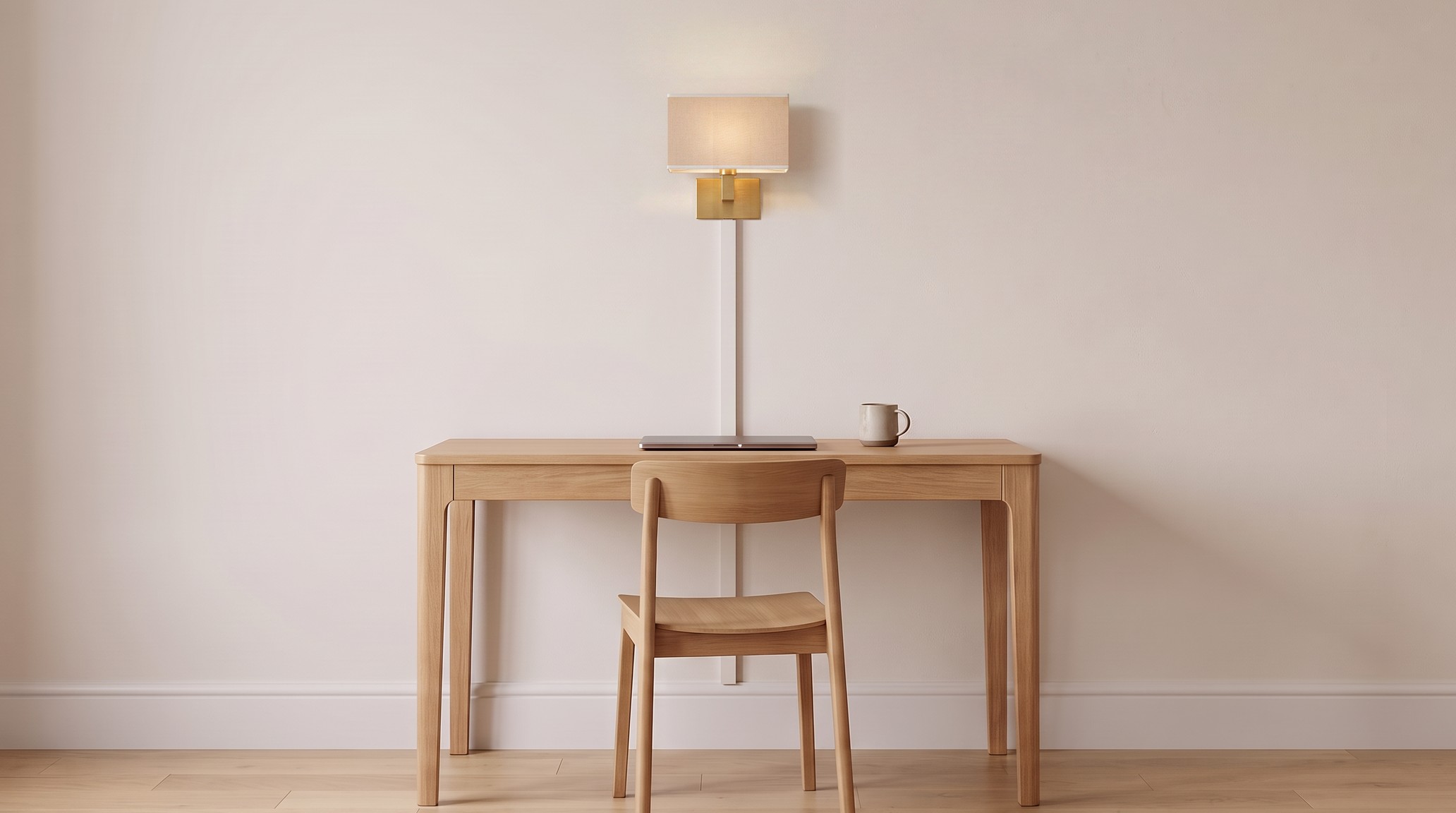
Why the light itself can give the trunking away
However well it is painted, trunking stands proud of the wall, and anything that stands proud casts a shadow when light skims across it. The closer the light source is to the wall, the longer that shadow. For trunking of depth d whose edge sits a distance x from the lamp, with the light source a gap g from the wall, the shadow beside it measures d × x ÷ (g minus d).
Take trunking 15 mm deep, 30 cm from the lamp. With a source only 4 cm from the wall, as on many slim LED wall lights that wash the wall with light, the shadow reaches 18 cm. With a bulb hanging 20 cm from the wall, it falls to 2.4 cm. A light that throws a pattern across the wall, such as our Light and Shadow Play wall light, shows every relief nearby just as clearly: keep its wall clear of trunking.

Three rules follow. Run the trunking straight down, in line with the lamp: the light then travels along its sides and the sideways shadow almost disappears. Keep horizontal runs low, just above the skirting, where the light is weakest. Close to the lamp, prefer a half-round cover, which gives the shadow no sharp edge to draw. The size of the source matters too: a shade or a globe in opal glass spreads the light over its whole surface and casts a softer, blurred shadow, far less visible than the crisp one from a clear bulb.
Make the flex a feature: straight lines rather than a loop
Some cables do not need to disappear. A fabric flex run in straight lines with square corners reads as a graphic line on the wall, as long as it never sags. A coloured fabric flex on a plain wall works best with a simple route: a vertical drop from the lamp, a right angle at the bottom, a horizontal run along the skirting to the socket.
Our tip: hold the flex every 30 to 40 cm with clips made for its size, plus one at each change of direction. Never pull it tight, crush it or staple through its sheath, and never run it under a rug, under a furniture leg or across a doorway, where it would wear without anyone noticing. Leave a little slack at the lamp end so the flex does not pull on its entry point.
Behind a headboard, a sideboard or a picture
The best cable cover is often a piece of furniture you already own. By the bed, the flex of a headboard wall light can drop behind the headboard, with 2 or 3 cm of space between the panel and the wall so it is never trapped. A sideboard or a desk hides the socket and the end of the run, as in our photo. In a closed cabinet, a cable grommet, a small collar fitted in a hole drilled through the back panel, stops the edge of the timber rubbing the sheath. Always leave the socket within reach, so you can unplug the lamp before changing the bulb.
Want to avoid a second cable running down to a wall switch? The lights in our wall light with switch range put the switch on the light itself, within reach of the bed or the armchair, like our adjustable wall light in gold-coloured brass, a compact reading light with a built-in switch.
Chasing, new outlets and sockets: work for a Registered Electrical Contractor
A cable you cannot see at all means a hardwired light: an outlet in the wall behind the back plate, fed by a protected circuit from the consumer unit. Creating that point, like adding or moving a socket, changes the fixed installation, which I.S. 10101 governs: cable size, circuit protection, earthing, how cables are run in the wall. The Commission for Regulation of Utilities (CRU) is plain about it: always use a Registered Electrical Contractor (REC) for electrical work in your home, and you can check that yours is on the Safe Electric register. A new circuit is also one of the Restricted Works that only an REC may carry out in a home, and for major work of this kind the REC gives you a Completion Certificate.
- Chasing. Cutting the channel is only building work, but it is there to take conduit and live conductors connected to a circuit: the whole job is the electrician’s, who chooses the route and depth to suit the wall. In a stud partition there is no chasing: the cable runs inside the cavity, again by the REC.
- The flex of a plug-in light. It is never buried under plaster, pushed into a chase or fed down inside a stud wall between two brush plates, a trick that circulates online: that flex belongs to the lamp and must stay visible, accessible, replaceable and unpluggable. In trunking that opens, yes; inside the wall, no.
- An outlet in the wrong place. If the existing outlet sits 20 cm from where you want the light, it is not extended with connectors left showing on the wall: the REC moves it, or you adjust the position of the light.
- If you rent. Under section 16 of the Residential Tenancies Act 2004, a tenant must not alter or improve the dwelling without the landlord’s written consent. Adhesive trunking that comes off cleanly is easy to agree; a new lighting point with chasing is an alteration: ask for written consent first.
In a bathroom, I.S. 10101 treats the room as a special location, with zones around the bath and the shower and the fittings allowed in each: new electrical work there is also Restricted Work, and we recommend a hardwired light installed by an REC. Outside, the same applies: no indoor flex and no extension lead, only equipment made for outdoor use.
Questions about hiding cables on wall lights
How do you hide wall light cables?
For a plug-in wall light, run the flex in slim trunking or a half-round cord cover painted the wall colour, straight down in line with the lamp, then along the skirting to the socket. You can also clip a fabric flex in straight lines or drop it behind a headboard or sideboard. A cable hidden inside the wall means a hardwired light, fitted by a Registered Electrical Contractor.
What is the best way to hide cables on a wall?
On a flat painted wall, the least visible option is a half-round cord cover or slim trunking painted with the wall paint, in the same finish. Keep vertical runs in line with the lamp and horizontal runs just above the skirting, where they catch the least light and cast the smallest shadow.
How do you disguise a lamp cord?
Paint the cord cover to match the wall, choose a fabric flex in the wall colour, or make it a feature with straight lines and square corners held by clips every 30 to 40 cm. Never crush, staple or pull the flex tight, and never run it under a rug or across a doorway.
Can I run a lamp flex inside the wall?
No. The flex of a plug-in light belongs to the lamp: it must stay visible, accessible and replaceable, so it is never buried in plaster, pushed into a chase or fed down a stud wall. A cable inside the wall is part of the fixed installation, covered by I.S. 10101, and is installed by a Registered Electrical Contractor.
Do I need an electrician to fit a wall light in Ireland?
For a hardwired wall light, yes. The Commission for Regulation of Utilities advises always using a Registered Electrical Contractor for electrical work in your home, and a new circuit is Restricted Work that only an REC may carry out. A plug-in wall light only needs fixing to the wall and plugging into a socket.
How do you hide cables on a wall without drilling?
Use self-adhesive trunking or cord covers on sound, clean paint, and route the flex behind furniture where you can. On flaky plaster or bare plasterboard the adhesive may not hold, so screw the trunking in place, drilling beside the flex and away from any cable already in the wall.
Sources
- I.S. 10101:2020, National Rules for Electrical Installations, which replaced ET 101:2008. National Standards Authority of Ireland (NSAI), presented by the Health and Safety Authority
- Works Needing Certification: Controlled Works and Restricted Works, section 9E(1) of the Energy (Miscellaneous Provisions) Act 2006. Health and Safety Authority
- Home safety: electrical works in your home, and the RGI and Safe Electric schemes. Commission for Regulation of Utilities (CRU)
- S.I. No. 525 of 1997, National Standards Authority of Ireland (Section 28) (13 A Plugs and Conversion Adaptors for Domestic Use) Regulations, regulations 4 to 6. Irish Statute Book
- Residential Tenancies Act 2004, section 16(l), obligations of tenants. Irish Statute Book
Related products

Wall Light in Beige Fabric and Gold-Coloured Metal

Gold Art Deco Wall Light with Ribbed Glass Tubes

Adjustable Wall Light in Gold-Coloured Brass
Find out more

GU10 Bulb: Lumens, Beam Angle, GU10 vs MR16 and How to Change One

Cosy Living Room Ideas: Where to Put Wall Lights and Which Light to Choose
How to Hide Wall Light Cables: 6 Safe Ways to Tidy the Flex


