


Table of contents
Opal glass is glass that is milky white right through its thickness: tiny particles trapped in the glass scatter light in every direction. On a wall light, it hides the bulb completely and spreads an even glow with no bright spot. The trade-off is that it lets through less light than frosted glass, so plan on a slightly stronger bulb.
Opal, frosted, ribbed or clear: the glass you pick decides what you will actually see on the wall once the light is on, whether that is a soft glowing volume, the outline of a bulb or a hard point of light. Here is what each type of glass does to the light, with figures, followed by the bulb settings that suit opal glass best.
What is opal glass?
Opal glass, also called milk glass, is an opaque or translucent glass, usually white. Its milky look is not a coat of paint or a surface finish: it is created in the mass, by adding opacifiers to the molten glass. Over the centuries, glassmakers have used bone ash, tin dioxide and compounds of arsenic or antimony. Some stay suspended in the glass, others form tiny crystals as it cools. That gives you a simple test: look at an edge, a rim or a broken corner. A true opal glass is white all the way through, whereas clear glass painted or coated white shows a transparent edge.
Those particles do not bend light in the same way as the glass around them. Every ray that meets one is deflected, then deflected again by the next: this is light scattering, the Tyndall effect of school physics books. Two signs give it away. Seen from the side in daylight, the glass takes on a faint bluish sheen; with a light shining through it, it turns warmer, towards orange.
The technique is old. Venetian glassmakers were already producing it in the 16th century under the name lattimo, from the Italian for milk, as a cheaper rival to porcelain. It went on to be used for tableware, vases and lamps. Collectors use the word “opaline” for the antique glassware produced in 19th century France, while “opal glass” is the everyday name of the material, the one you will find on many of our ball wall lights.
Opal, frosted, ribbed or clear: what each glass does to light
Frosted glass is clear glass with one face roughened, either mechanically (sandblasting, grinding) or in an acid bath that leaves a satin feel. The scattering therefore happens at the surface, over a tiny depth, whereas opal glass scatters light through its whole thickness. Ribbed glass carries moulded grooves that break the light into lines. Clear glass scatters nothing at all: you see the bulb as if through a window pane.
| Glass | Where the effect comes from | What you see when it is on | Light transmitted (flat sheet) |
|---|---|---|---|
| Clear | Nothing, the glass is transparent | The bulb in sharp detail, a very bright point | 90% and over |
| Ribbed | Grooves moulded into the surface | Lines of light, the bulb half visible | Depends on the pattern |
| Acid-etched frosted | One face satinised by acid | A brighter patch where the bulb sits | 49 to 88% (glazing) |
| Sandblasted or ground | One face made rough | A softened glare, a blurred outline | 40 to 50% (diffuser) |
| Opal | Particles throughout the mass | An even glowing volume, no bulb in sight | 30 to 40% (diffuser) |
The third column sums up what we see on the models we sell; the last one gives the figures of two manufacturers, explained below. The rule to remember: the better a glass hides the bulb, the more light it holds back. Opal glass sits at the far end of that scale, and that is the price of its softness.
Ribbed glass is a case apart. Its grooves bend the light more than they scatter it, and the pattern they throw onto the wall is part of the effect. The gold Art Deco wall light with ribbed glass tubes plays that graphic card: the bulbs show as streaks of light behind the glass, the very opposite of the uniform glow of opal. You will find more of these sculptural pieces among our designer wall lights.
How much light gets through opal glass
The clearest figures come from two glass manufacturers. For clear building glass, the technical data sheet gives a light transmission from 90%. For acid-etched glass, the same manufacturer gives between 49 and 88% depending on thickness and tint. On the optics side, a maker of optical components states that a ground glass diffuser lets through roughly 40 to 50% of visible light and an opal glass diffuser roughly 30 to 40%, adding that opal spreads light more evenly but loses more of it.

These values are measured on flat sheets that the light crosses only once. A globe does better than a sheet: the light that the glass sends back inwards bounces off the opposite wall of the globe and part of it gets out in the end. An opal globe therefore delivers more than its 30 to 40% as a flat sheet, but it remains the type of wall light glass that holds back the most light. Thickness matters too: the thicker and whiter the opal, the more light it keeps.
The practical consequence is simple. With the same bulb, a wall light in clear or frosted glass puts more light into the room than one in opal glass. If your wall light has to light a hall or a landing, and not just decorate it, our advice is to go one step up in lumens compared with what you would fit behind frosted glass, without ever exceeding the maximum wattage marked on the fitting.
Why opal glass does not dazzle
What dazzles is not the amount of light but how concentrated it is: luminance, the light given off by each square centimetre of the surface you look at. A bare G9 LED capsule, about 1.5 cm across and 4.5 cm long, sends out its whole output from some twenty square centimetres. Spread by opal glass over the full surface of a 12 cm globe (452 cm²), the same output is about twenty times less concentrated, before you even count the light the glass holds back.
That is why you can look at an opal globe without discomfort, even at eye level on either side of a mirror or just above a bedside table, where clear glass would leave a bulb staring back at you. Coming from a larger surface, the light also softens the shadows on a face.

Frosted glass does better than clear glass, but not as well as opal: since the scattering happens at the surface, a brighter patch stays visible in front of the bulb. On a wall light you pass at eye level in a hall, the difference shows straight away. For small spaces where the wall light is seen up close, such as a hall, a landing or a bathroom, opal is the most comfortable choice. Our corridor and staircase wall light guide covers placement in those areas.
Which bulb to use behind opal glass
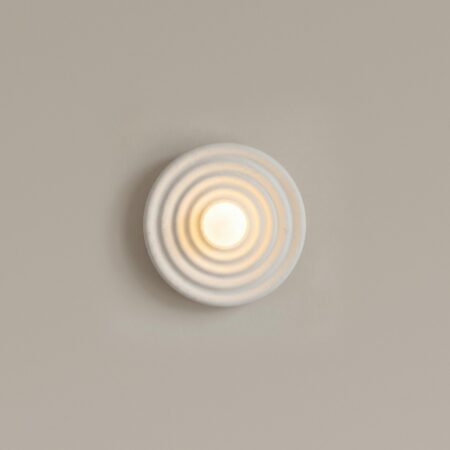
Most small opal glass wall lights take a G9 capsule, as does our Japandi model with its opal globe. You have three settings in hand.
- Light output. It is given in lumens on the box. The official EU equivalences put an old 40 W incandescent bulb at 470 lm and a 60 W at 806 lm. Behind opal glass, aim for the top of what the fitting allows; on our ribbed glass model, for example, the limit is 8 W.
- Colour temperature. Opal glass turns slightly warmer as light passes through it. With a 2,700 K LED, the globe glows a creamy white; at 4,000 K, it looks distinctly colder. For a living room, a bedroom or a hall, our advice is to stay with warm white, at 2,700 or 3,000 K.
- The shape of the source. Behind thick opal, the bulb’s shape disappears. Behind thin glass or frosted glass, choose a capsule that glows over its whole surface rather than one with small visible LED chips, which print dots on the glass.
To light the whole room, our house rule still applies: floor area × target lux × 2 gives the lumens to install. A 4 m² hall lit to 100 lux therefore needs 4 × 100 × 2 = 800 lumens, shared between the wall lights and the ceiling light. With opal glass wall lights, stay at the top of that range.
Where to put an opal glass wall light
Opal glass shines wherever the light source is seen up close.
- The bathroom. On either side of the mirror, two opal globes light the face from the front, without the shadow of the head. In Ireland, a room containing a bath or shower is a special location under I.S. 10101, the National Rules for Electrical Installations: the space around the bath and the shower is divided into zones, zone 0 inside the bath or shower tray, zone 1 directly above it and zone 2 around zone 1, and each zone sets the minimum IP rating and the type of fitting allowed. Installing or replacing an electrical installation in that room is Restricted Electrical Works under S.I. No. 264 of 2013: in a home, only a Registered Electrical Contractor may carry it out. Choose the fitting with them before you buy, from our bathroom wall lights, where each product page gives its IP rating.
- The hall and the landing. A small opal globe or a round wall light with an opal centre lights the way without dazzling whoever walks in.
- The bedroom. For a soft glow on either side of the bed, opal glass gives a restful light. For reading, it is not enough on its own: its light goes in every direction, not towards the page. Pair it with a reading light, as our bedroom wall light guide explains.
- The living room. In a row, several opal globes form a line of soft dots; for one striking piece, choose a wide disc with an opal centre from our round wall lights.
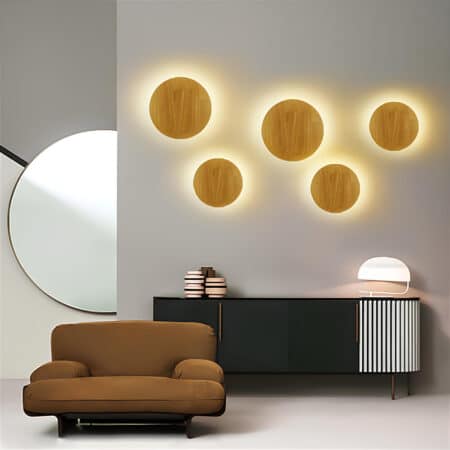
If all you want is never to see the bulb, there is a second route that needs no glass at all: indirect light. Our round wooden wall light hides its source behind a solid disc of wood and sends its light back against the wall, where it draws a halo around the disc. Frosted glass, for its part, keeps the edge when you need more light from the same bulb. The calm, natural look that suits opal so well is gathered in our Japandi wall lights.
Opal glass: frequently asked questions
Are opalware and opal glass the same?
They are the same family of material: a glass made white and milky throughout by opacifying particles. Opalware is the name used for tableware made from it, plates, bowls and mugs, while lighting speaks of opal glass for globes and shades. In both cases light passes through the glass but is scattered in every direction.
How can you tell if something is opal glass?
Look at an edge, a rim or a chip: true opal glass is white right through, whereas clear glass painted or coated white shows a transparent edge. Hold it up to a light as well: opal glass glows evenly and turns slightly warm, with no clear outline of the bulb behind it.
Is opaline glass valuable?
For an antique piece, the value depends on the period, the colour, the decoration and the condition: only a specialist or an auctioneer can put a figure on it. A new opal glass wall light is worth having for the quality of its light rather than for its rarity.
What is opal etched glass?
In lighting descriptions, opal etched usually means clear glass whose surface has been acid-etched to look milky. It is a frosted glass that imitates opal: the scattering happens at the surface, not in the mass, so a slightly brighter patch can remain in front of the bulb. The edge test tells them apart.
Is opal or frosted glass better for a wall light?
Opal if the wall light is seen up close and mainly has to give a soft light: bathroom mirror, hall, landing, bedside. Frosted if it has to give more light from the same bulb. Behind opal glass, choose a slightly stronger bulb, within the maximum wattage marked on the fitting.
Can I put an opal glass wall light in a bathroom in Ireland?
Yes, if the fitting has the IP rating and type required for the zone where it goes. Under I.S. 10101, the space around the bath and the shower is divided into zones with their own requirements, and the glass itself does not mind humidity. The work is Restricted Electrical Works: it is for a Registered Electrical Contractor.
Sources
- Milk glass: definition, opacifiers (bone ash, tin dioxide, arsenic and antimony compounds), lattimo made in Venice in the 16th century; Opaline glass: 19th century French glassware. Wikipedia
- Tyndall effect: opalescent glass appears blue from the side, but orange light shines through. Wikipedia
- Clear float glass (light transmission from 90%) and acid-etched glass (light transmission between 49 and 88%), product data sheets. A flat glass manufacturer
- You have three types of diffusers: opal glass, ground glass, holographic. Which one is right for my application? (transmission of roughly 30 to 40% for opal glass, 40 to 50% for ground glass). A supplier of optical components
- Commission Delegated Regulation (EU) 2019/2015, Annex V, Table 7 (equivalence between luminous flux and the power of incandescent bulbs). Official Journal of the European Union
- I.S. 10101, National Rules for Electrical Installations: locations containing a bath or shower (Part 7, special locations). NSAI
- S.I. No. 264 of 2013, Electricity Regulation Act 1999 (Restricted Electrical Works) Regulations 2013, Regulation 4(2)(b). Irish Statute Book
Related products

Gold Art Deco Wall Light with Ribbed Glass Tubes
Round Japandi Style Wall Light
Round Wooden Wall Light
Find out more

GU10 Bulb: Lumens, Beam Angle, GU10 vs MR16 and How to Change One

Cosy Living Room Ideas: Where to Put Wall Lights and Which Light to Choose
How to Hide Wall Light Cables: 6 Safe Ways to Tidy the Flex


